
A long-term learning partnership with Rochdale Culture Co-op, co-designing a practical approach to Arts Excellence and using participatory evaluation to understand how community-led culture creates quality, agency, belonging and lasting change.
The opportunity
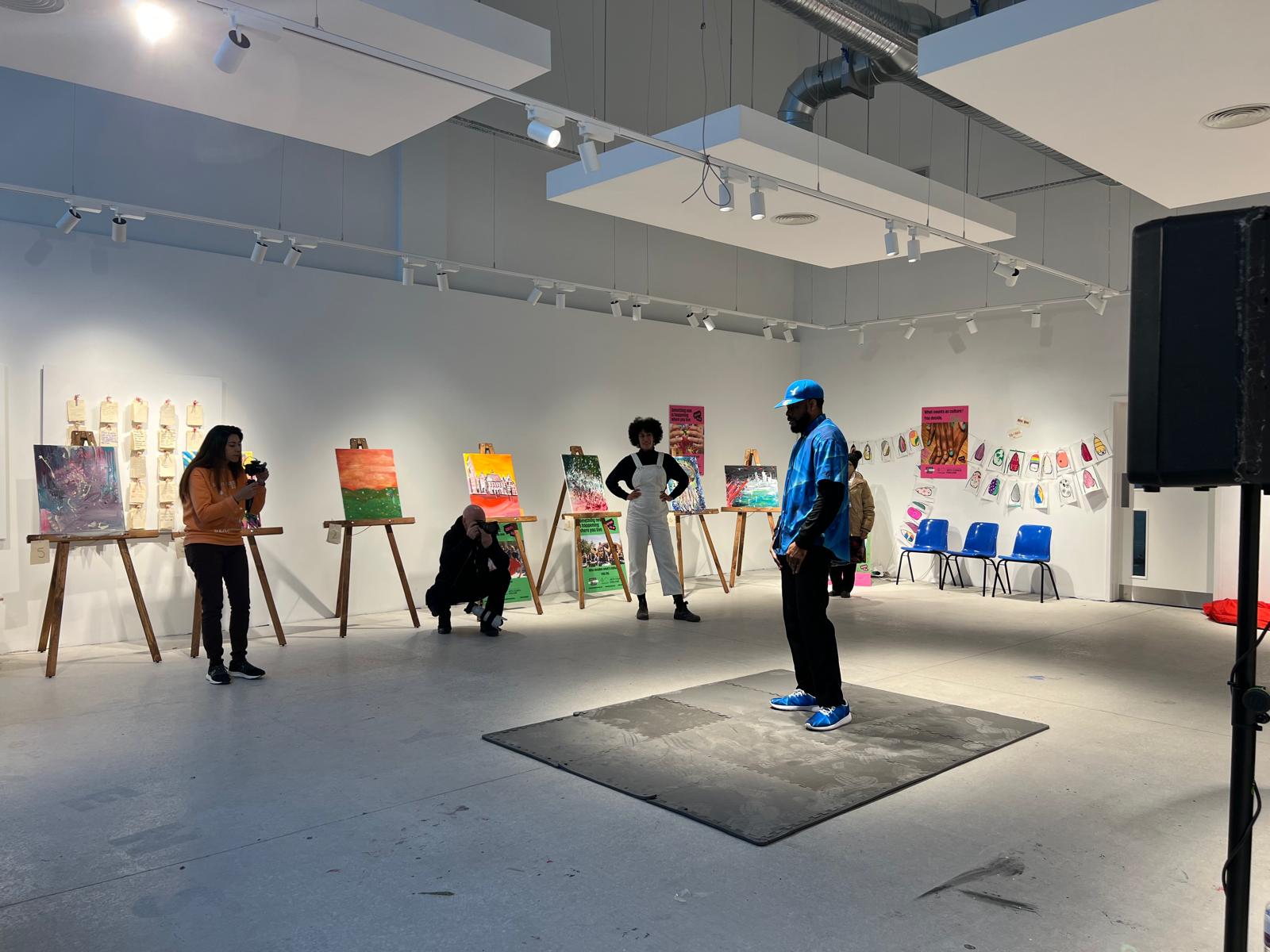
Since 2024, Local has worked alongside Rochdale Culture Co-op, an Arts Council England Creative People and Places programme, supporting the team to understand, articulate and evidence the quality and impact of its community-led approach.
At the heart of Culture Co-op is a deceptively simple proposition: local people should have meaningful power to shape the culture of their communities.
Through its Cultural Pioneer model, residents are not simply audiences or consultees. They develop ideas, commission activity, work alongside artists, allocate resources and help determine what culture looks like across Rochdale.
That creates an important evaluation question.
If communities have greater agency in deciding what culture is and how it is made, who decides what artistic excellence looks like – and how should it be recognised and measured?
This question became the starting point for an ongoing collaboration between Local, Culture Co-op Director Greg Bond, the wider team and Cultural Pioneers.
Developing the Arts Excellence Framework
Creative People and Places programmes are asked to consider excellence in both artistic output and the process of engaging communities.
But ideas such as quality and excellence can become abstract – or reproduce professional definitions of what constitutes “good” culture.
Working closely with Greg Bond and Culture Co-op, Local co-designed an Arts Excellence Framework to make that conversation more useful, practical and democratic.
Rather than providing a scorecard or fixed definition of excellence, the framework creates a structure through which communities, artists and producers can ask better questions about the work they are creating together.
It considers interconnected dimensions including connection and understanding, experience, duration, scale, practitioner integrity, and the harder-to-quantify moments of “magic” and change. These sit alongside considerations such as relevance, widening participation, creative ambition and risk, authenticity, production values and longer-term impact.
Crucially, we designed the framework to do more than evaluate completed activity.
It can also be used as a planning and reflective tool – helping Cultural Pioneers think about quality while ideas are being developed, commissioned and delivered.
That distinction matters. It moves evaluation upstream, making reflection part of creative decision-making rather than something imposed at the end of a project.
From framework to evaluation
The next phase of our collaboration tested those ideas through the Cultural Pioneer programme itself.
Local developed a qualitative evaluation process structured around the Arts Excellence Framework, exploring experience and connection; process and decision-making; quality and “magic”; change and impact; and longer-term ambitions.
We worked with Cultural Pioneers representing five different place-based and thematic panels – Middleton, Heywood, Northern Lands, Islamic Art and Queer Publishing – using semi-structured conversations to understand not only what had happened, but how participants experienced quality, decision-making, ownership and change.
Rather than using the framework as a scoring mechanism, we used it as a provocation for reflection and conversation.
This enabled the evaluation to explore questions that conventional output measures can struggle to capture: Who felt ownership? Whose voices influenced decisions? What made an experience meaningful? When did something feel ambitious or surprising? What helped people belong? And what might endure beyond the programme itself?
What we learned
Across very different Cultural Pioneer panels, a remarkably consistent picture emerged.
Participants rarely defined excellence through artistic output alone.
Quality was associated with relevance, authenticity, participation, belonging, creative ambition and emotional and social impact. The evaluation found increased confidence and skills, new relationships and networks, greater engagement with arts and culture, stronger visibility for local stories and identities, and opportunities for communities to create shared cultural experiences.
One of the strongest findings concerned power.
Cultural Pioneers valued being trusted not simply to contribute opinions, but to make decisions. The programme's culturally democratic approach was enabling a shift from participation towards agency and, increasingly, community leadership.
The evaluation also surfaced something less expected: Culture Co-op was functioning as a form of social and wellbeing infrastructure, creating spaces of connection, identity, confidence and belonging across very different communities.
From evaluation to action
Our work with Culture Co-op has never been about producing a report and walking away.
Because Local has worked alongside the programme over time, evaluation has become part of an ongoing cycle of design → delivery → reflection → learning → adaptation.
Insights from Cultural Pioneers have informed an evolving action plan and priorities for the programme's next phase, including strengthening infrastructure, supporting progression and leadership, embedding evaluation and learning, and creating the conditions for community-led cultural activity to become more sustainable.
The work has also generated learning about the Arts Excellence Framework itself.
Cultural Pioneers described its prompts as useful conversation starters, while also identifying that the framework works best when there is sufficient time and facilitation – and, importantly, when it is introduced during the development of activity rather than solely as retrospective evaluation.
That learning is helping the framework evolve alongside the programme.
Why it matters
Our collaboration with Culture Co-op has reinforced an important principle in Local's practice:
Community-led culture does not require us to lower our expectations of artistic excellence. It asks us to think more deeply about who defines excellence in the first place.
When communities have genuine agency, quality becomes multidimensional. Artistic ambition still matters. So do skilled practitioners, strong ideas and high production values.
But so do relevance, relationships, accessibility, trust, ownership and the quality of the process through which culture is created.
For Local, Arts Excellence therefore isn't simply an evaluation question. It is a question about cultural democracy.
Our emerging work with Culture Co-op suggests that the most useful frameworks don't provide communities with somebody else's definition of excellence. They create the conditions for communities, artists and organisations to recognise, discuss, plan for and strengthen quality together.
And that is perhaps the most important finding from our collaboration so far: when communities shape culture themselves, excellence is not diminished. It is redefined, expanded and strengthened.
Our role
Over our collaboration with Culture Co-op, Local's work has included co-designing the Arts Excellence Framework; developing participatory evaluation methods; facilitating reflective learning; interviewing Cultural Pioneers; analysing qualitative evidence; reviewing community-led decision-making and impact; translating learning into strategic recommendations; and supporting the team to embed evaluation within future planning and practice.
The wider programme of work has deliberately combined framework development, evaluation, learning and capacity-building rather than treating these as separate exercises.


